How to use this site: This page is a chapter in an online book. If you’ve arrived here without reading the previous chapters first, it might not make much sense. I strongly recommend you start at the beginning. Click here to go to the beginning.
Chapter 8
Understanding the Challenge of Comfortable and Fluent Reading With a Vision Impairment
Fluent reading requires both comfort and speed. Comfort is not so hard to achieve, but speed is a next-level challenge. We examine how our eyes normally achieve reading fluency, and how vision impairment can interfere with the process.
Why is comfortable, fluent reading important?

Fluent, comfortable reading is not important to everyone.
I mean, a lot of people never ever become fluent readers, and they live full and rich lives without it. So if they develop an eye condition that makes it impossible for them to achieve comfortable, fluent reading… well, that’s a bit like me developing a condition that makes it impossible to bounce around on a pogo stick (I’ve tried, I’ve fallen, I’ve hurt myself — I’m no good at it, but it doesn’t bother me that pogo sticks are not a part of my life, so I really don’t care).
But for many of those who do become fluent readers, immersive reading becomes a core part of their quality of life. For ‘bookworms’, a loss of that ability feels like a tragedy. On top of that, many who develop vision impairment get it in their elderly years, at a time when they’re more likely to be developing issues with the rest of their body that make it harder for them to do alternative pastimes such as gardening, cooking, and walking. So this is exactly the time when they want to be able to enjoy the simple pleasure of ‘losing themselves’ in a book.
“To acquire the habit of reading is to construct for yourself a refuge from almost all the miseries of life.”
William Somerset Maugham
The loss of your habitual escape from those ‘miseries of life’ can be very significant. So, yes it’s true that nobody needs to be able to read fluently and comfortably, but for many people it’s one of their top priorities, so we need to take it seriously.
Unfortunately, the fact that it’s not a true need means it doesn’t always get the careful consideration that I feel it deserves. This chapter and the next couple are intended to provide that careful consideration.
By the way, if fluent reading is really not your jam, you might want to skip these chapters and jump straight to chapter 11.
How is Fluent Reading Different?
‘Reading’ is a term that covers a broad spectrum of interpreting symbols as language. At one end of the spectrum is spot reading, which is where you’re reading just a little bit of text like a name tag, a price tag, a phone number or a recipe. Spot reading is purely informational — it’s important that you read it accurately, but it doesn’t matter whether you read it quickly or comfortably. Spot reading is essential in maintaining your independence. Everything we dealt with in Section 2 relates to spot reading.
Then there’s prolonged informational reading — things like reading a newspaper or magazine article, or looking through a bank statement. Accuracy is important, but comfort too, since you’re doing it for longer. And it’s helpful if you’re able to keep up at least a medium reading speed, but it’s not essential. How long you can read depends on a balance between how comfortable it is and how determined you are to read the article.
Right at the top end of the scale is immersive reading, the reading people are talking about when they say ‘I love reading books’. It’s reading for pleasure, following a narrative. The essential characteristics are fast-fluency and comfort.
- Obviously, you need to be able to keep up a certain pace, most especially if you are reading a story. It’s kind of like music — sure, you can listen to your favourite song on one-quarter speed, and hear every note exactly as it should be, but if the pace isn’t there then it’s not really music, it’s not really the song.
- It needs to also feel comfortable enough that you aren’t too conscious of reading, but rather are able to ‘lose yourself’ in the narrative. If you’re constantly straining to read, it breaks you out of the immersion, so there needs to be a degree of comfort.
This fast, fluent and comfortable reading is a really high-performance visual task, so it’s not surprising that it’s one of the first to be affected when vision becomes impaired.
Just How Fast is ‘Fluent’?
Definitions vary, but here are the definitions I’m using:
- Slow: below 120 words per minute.
- Medium: 120 to 180 words per minute (kind of ‘slow-fluent).
- Fluent: 180 to 270 words per minute.
- Fast-fluent: Over 270 words per minute.
You might think 120 words per minute sounds like a lot, but try speaking at that speed, two words per second — you’ll sound a bit like a slow robot. So below 120 wpm is definitely quite slow.
As for ‘fluent’, 180 words per minute is a normal conversational speed, so it sounds great when people read text aloud at that rate. But people who read a lot may have silent reading speeds way faster than that. That’s why I think it’s important to include a higher mark, ‘fast-fluent,’ at 270+ wpm (50% faster than the basic ‘fluent’ threshold). For an avid reader, ‘fluent’ is the mark for acceptable, but ‘fast-fluent’ is what many bookworms are searching for.
Fast fluency is hard to measure
It’s actually kind of hard to tell if someone is achieving fast fluency. Normally we’d get people to read their book out loud for a minute, and just measure how many words they get through.
But 180 is about as fast as you can speak for a minute flat, and speaking three or even four hundred words a minute is really not something most people can manage. I mean, auctioneers, rappers, and perhaps those people who speak the ‘legal fine print’ at the end of an advertisement could do it, but us regular folks can’t. And even if you can, it sounds weird.
So we pretty much just have to give you a page of a book and ask you to tell us when you’ve finished it, and take you at your word. If we want to be more sure about it, we’d ask you comprehension questions to make sure you’re really taking it in and not just flicking your gaze over the words — but that’s something I’d only think about doing if it was part of gathering data for a proper study, not a general clinical context.
How much fluency is enough?
For spot reading, medium speed is desirable, but even very slow can be adequate.
For prolonged informational reading, you’d be hoping for fluent, but medium can be acceptable. Slow makes it a real chore.
For immersive reading, fluent is acceptable, but fast-fluent is what most bookworms have been used to, and therefore what they are seeking to return to doing. Medium is too slow to be consistent with proper immersion, although some people might find it just acceptable, if they are really determined to read the book.
The limitations of the word ‘reading’
‘Reading’: the word covers such a wide range. And I think its inherent lack of precision is behind a lot of frustration with low vision rehabilitation. ‘I’m having trouble reading’ is a complaint that covers a huge variety of problems, and the potential for miscommunication is high.
Let’s dig into this.
Imagine if we had to pick just one word — let’s choose ‘ambulate‘ — to be the only term to describe moving on our two legs. Shuffling, walking, jogging, running, and sprinting — none of those words exist. Just ‘ambulate’.
Now imagine two people going to the ‘ambulation doctor’ because they’re ‘having trouble ambulating’ (but in very different ways).
- One person might be struggling even to stand, let alone shuffle. They say, “Doc, please help me — I’m having trouble ambulating.”

- Another person might be a long-distance runner — they can walk easily, but their issue is they are now having difficulties keeping up the pace with their marathons. They say, “Doc, please help me — I’m having trouble ambulating.”

Clearly these are extremely different situations — but because of the limited language, to the ambulation doctor they sound the same.
For the person who couldn’t even stand, the problem is clear and obvious. If the doctor gets them shuffling they’ll be pleased. If they can get them walking properly, they’ll be over the moon!
But the situation with the runner is likely to result in confusion and frustration on both sides.
- From the doctor’s perspective, this person has nothing to complain about — they are ambulating (walking) perfectly well already, quite normally. The doctor will probably feel that the runner just needs some reassurance that nothing’s actually wrong.
- But from the runner’s perspective, they won’t feel reassured. Instead, they will leave feeling frustrated — unheard and unhelped, and still unable to manage that activity that they used to enjoy so much.
In situations like this, it’s really important to go beyond the basic complaint of ‘I’m having trouble ambulating’ to get more detail. What kind of ambulation are you talking about? What kind of ambulation were you accustomed to doing previously? What kind of ambulation are you aiming to return to doing?
The parallels with reading are obvious.
- Slow reading is like shuffling. Fine if you just need to get a short distance from A to B. It’s incredibly helpful to your independence if you can at least shuffle, very limiting if you can’t.
- Medium reading is like walking. Most of us do it all the time without even thinking about it. Sure, some walk more than others, but the main thing is you can do it.
- Fluent reading is like jogging. Some people never do it. Others are regular joggers.
- Immersive reading (being a bookworm) is like being a marathon runner. It’s a challenging task, for people in peak condition. But for those that are accustomed to doing it, it’s a big part of life enjoyment and fulfilment, and not being able to do it is a serious loss.
When someone reports problems with ‘reading’, it’s important that everyone involved dig into that term in more detail, and be clear about exactly what sort of reading task you’re talking about. Understanding the reading task lets you know the sort of speed you need to achieve to get success.
Good communication is key. Having a problem properly defined is a critical foundation step in determining how (or whether) it can be solved.
“Be clear about exactly what type of reading you’re talking about.”
Comfort: Reading and Gardening
Back to gardening!
Remember in Chapter 5 we looked at what a plant needs to survive, and discussed how that is analogous to the factors that our vision needs to see? Let’s extend that analogy further.
Consider: if you give a plant just barely what it needs to survive, sure, it will survive. But it will grow very slowly.
As gardeners, we want out plants to thrive, to flourish — to grow big, with healthy green leaves and beautiful flowers.

To thrive, your plants need much more than the bare essentials. They need an optimal amount of light, an optimal amount of water (not too much, not too little), and an ample supply of nutrients.
When it’s longer than spot reading, it needs to be comfortable
For spot reading, accuracy is important. Comfort is desirable, but it’s not essential. In contrast, when we are needing to read for longer periods, it’s no good if we’re struggling the whole time — that is, comfort becomes an essential factor.
How do we make sure reading is comfortable?
Just as plants need optimal conditions to thrive, our visual system needs optimal conditions for reading to be comfortable.
- We need the print to be a comfortable size, not just the smallest we can manage. Traditionally, in terms of letter size we consider this to mean that the text should be at least twice as large as the smallest text that we can read.
- We need a very good level of illumination, bright but without being glary.
- We need the words to have ample contrast, to comfortably stand out from the background and not be too pale.
These three factors are often known as The Three Bs — making things Bigger, Bolder and Brighter.
Bolder
Bigger and Brighter are pretty self-explanatory. ‘Bolder’ here is used in the sense of ‘boldly standing out from the background’ — that is, more contrast — rather than using a bold font.
In fact, using a bold font often does help, but what it’s doing is making the stroke width of the character wider, so technically that counts as bigger, not bolder.
Comfort means having adequate ‘reserve’
In technical terms we would consider these optimal conditions as meaning that the text should have an adequate amount of reserve. Size reserve (or ‘acuity reserve) means the text needs to be at least twice as large as the smallest text you can read.
Contrast reserve and illumination reserve aren’t so often considered, but don’t overlook them — they are just as important as size reserve. If the light’s too dim, it’s not going to make for a comfortable reading experience, no matter how large the print is.
Tractors vs Cars
Spot reading is kind of like getting from A to B on an old tractor. You just need to go a short distance, so it doesn’t really matter if it’s slow or uncomfortable — the main thing is that you get there. The trusty old tractor will get you there every time.

Prolonged informational reading needs something better, more like a modern sedan. It’s quieter, smoother, and it lets you travel for longer periods without getting tired or uncomfortable.

Will the sedan get you there more quickly? It certainly might, but there are other factors at play — see the section coming up. But even if it doesn’t get you there quickly, it’s still nice having the comfort, if you’re going to be sitting in it for a good long while.
For comfort, we need adequate ‘reserve’ — not just in print size, but also in contrast and brightness.
Yes, comfort is essential for speed — but it might not be enough
Having adequate reserves is an essential factor in being able to read quickly. Having print that is uncomfortably small, dim or pale will definitely slow you down.
So, let’s assume we’ve done it — we’ve got a stronger magnifier, and better light, and made sure the text is decent quality black & white. The individual letters are all easy to see. Surely now we’ll be able to read at our old normal fluent rate, right?
Well, maybe?
I mean, this is pretty much what we vision professionals are taught. And yes, sometimes it is as simple as that. It’s certainly an excellent first step — definitely try it. But the reality is that many people with vision impairments struggle to read with any fluency even under those optimal conditions that let them to see each individual letter comfortably.
Why is that?
To answer that, we need to do a deep dive into how our eyes achieve the task of reading quickly.
Speed: How Do We Read With Fluency?
In theory, it sounds simple to read fluently. I mean, if we know how to read slowly, we just get our eyes to do the same thing but faster, right?
We know already that we see fine detail by pointing our gaze so the image of that detail lands on our fovea. So it seems like it would make sense that reading is just a matter of sliding our gaze (saccading) along a line of text, so our fovea identifies every letter, one by one. Once we’ve seen all the letters in a word, then we know what the word says. Once we’ve read all the words in a sentence, we know what the sentence says. Easy.

And yes — that does work, for slow reading. But it doesn’t work for fast reading. I mean, there are at least a couple of thousand letters on every page of a book — that would mean many hundreds or thousands of tiny saccades.
Reading that way is kind of like giving you a great big bowl of soup, but with one of those tiny mustard spoons to eat it with. Can you eat the soup with such a tiny spoon? Sure, of course — technically you could eat the entire bowl of soup with even the tiniest spoon — but it would be super-slow, and I wouldn’t blame you if you felt that the dining experience was far less than satisfactory.
So speed is important for pleasurable reading. Let’s look into exactly how our eyes manage to read quickly.
Key concept: Reading with fast-fluency is a triumph of teamwork, a cooperative dance between the fovea, sections of the macular field, and higher processing areas of the brain. Problems with any of those parts can limit fluency.
1: The fovea looks at the beginning of a word.
Remember, the foveal field is tiny, so small that it can only see about 2-3 letters in one go, depending on the print size. But it will be able to identify those letters with high accuracy.
2: The broader macular field sees what’s coming up next.
While the fovea is fixating those first few letters, the macular field has it’s own job. The specific part of the macular field we are interested in is the area directly to the right of the fovea, which is the part seeing the next letters and words in the line of text. It can’t see detail as well as the fovea, but it still sees a lot of useful detail: it can detect the uprights and drop-downs of letters like b, d, p, t, etc; it may detect some of the squiggles like s; and it detects the gaps that separate the words, and therefore the length of the words.
I call this area the reading navigational field. It’s as essential as the fovea for fast-fluent reading.
3: The brain interprets that data.
The brain can do a lot with that information. Given the first few letters of the word (from the fovea), the length of the word, the position of uprights and drop-downs, etc (from the reading navigation field), that is often enough for the brain to determine what the word is. Even if there are multiple words that could match, the context of the text often gives an indication of which one of them will be the right one — a bit like the way predictive text works on our smartphones.
This process isn’t always 100% accurate, but it’s accurate often enough. Sure, we do sometimes need to backtrack to check on a word that we misread, but that’s a minor bother compared to the time saved by skipping along a line of text without having to look at each word with our fovea.
4: The brain directs our fovea to saccade to a new position.
The brain now decides where to get the eye to look next. Exactly where that is depends on how carefully we are reading, and how confident our brain is of its conclusions about the following words. If we are reading carefully, or the text is complex, with long or difficult words, the saccade will be short — with a long or unfamiliar word it might only be along to the next section of the same word.
But if we are reading an easier text, with a familiar vocabulary and context, our brains might be able to draw good conclusions about two, three or even four words in one go, which really supercharges reading speed. For more, here is an interesting news article that discusses recent findings: Human brain can process certain sentences in ‘blink of an eye’, says study.
Abcess Radio?
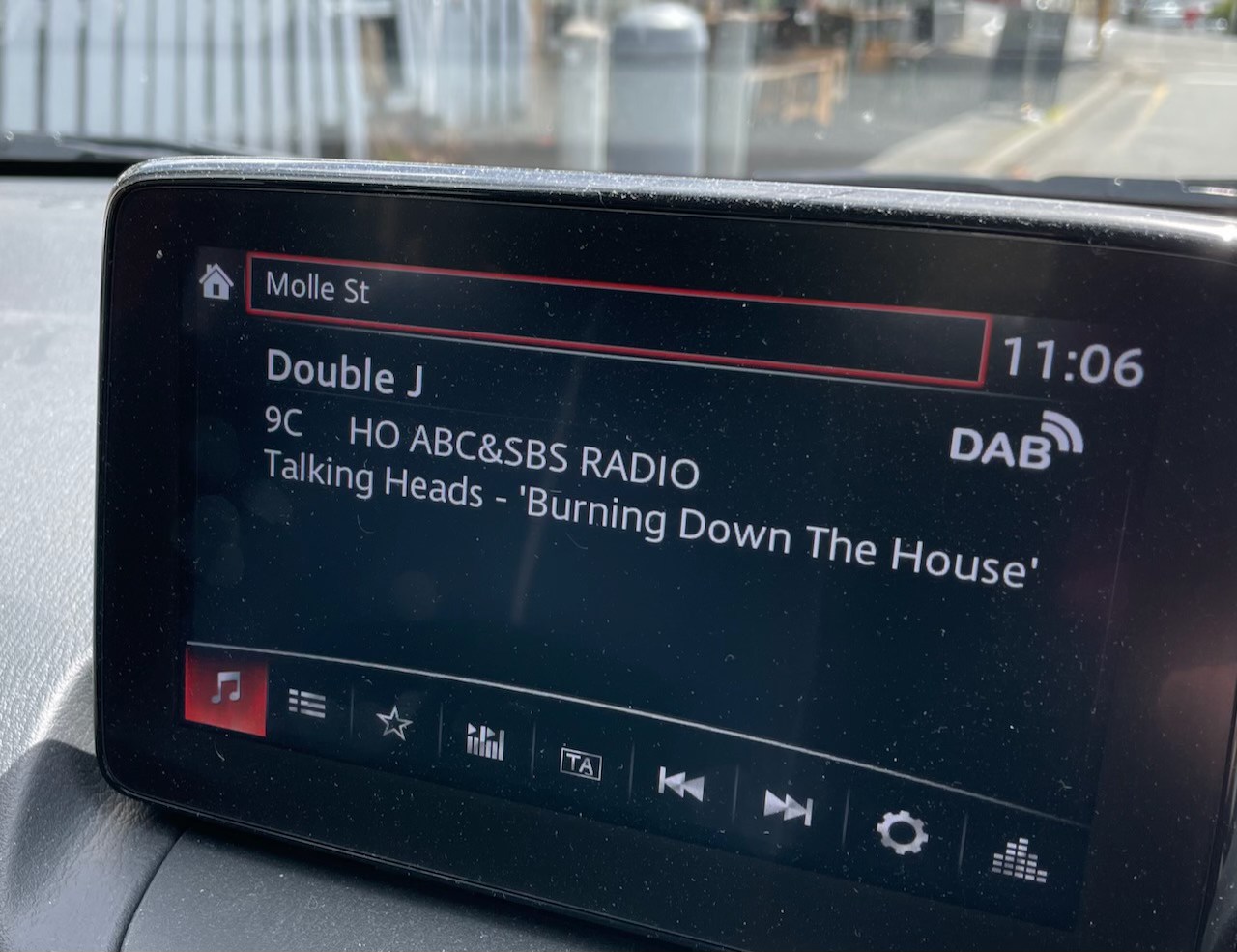
This is what shows up on my car radio when I’m playing an ABC station. I’ve noticed that whenever I glance at it, my brain always initially reads the word as ‘abcess’ — I can’t help it. It’s what the reading centres in my brain come up with when presented with a medium-length word that starts with ‘abc’ and has some ‘s’s (esses?) near the end. I mean, can you think of any other word it could be?
So that’s the reading centres in my brain automatically processing the info it’s getting from my fovea and reading navigation field (see below), and telling me (wrongly) what it says. I expect that eventually my brain will get used to ABC&SBS being a new ‘word’ and then it won’t keep telling me it’s ‘abcess.’
Nonsense Text?

You might have seen this come up on your social media feed from time to time. The explanation they give is kind of right and kind of wrong — see this article for some more in-depth discussion. But the main thing is that, yes, it is pretty easy to read the text even when some of the letters are mixed up, without needing to necessarily look at each individual letter. Some of the words need a second glance (a second foveal saccade), but many of them we can quickly figure out from very minimal information such as first letter, length, and context.
Key Concept: Macular Field Degradation
So now we’ve covered how we read at high speed. It’s a triumph of teamwork, a cooperative dance between the fovea, sections of the macular field, and higher processing areas of the brain.
Let’s return to the question in the previous section now: if we’ve got the text comfortable to see, does that mean we should be able to read with full fluency?
The answer to this really depends on whether your broader macular field is still largely intact — and if it’s not, exactly how badly has it been affected?
It can be incredibly frustrating — it’s perplexing to be able to see individual fine details so well, but find you still can’t read fluently, even when the print is very large.
This degradation of the macular field — more specifically, degradation of the reading navigation field, that area just to the right of where you are looking — is something we see all the time in the low vision clinic. It can happen even when your fovea has been completely spared, so you still might be able to read a long way down the visual acuity chart, and might still be able to read even legal fine print… but only slowly. It can be incredibly frustrating — it’s perplexing to be able to see those individual fine details so well, but find you still can’t read fluently, even when the print is very large.
People often tell me the print looks jumbled, or that the words jump around or move. That’s because the blind spots make parts of letters and words come in and out of view as your eye moves, which keeps changing the overall appearance of the words. Your brain interprets the changing shape of words as them moving. Others find they’re frequently reading words wrong — finding that the sentence doesn’t make sense, and having to backtrack to check each word slowly and carefully to get the words right.
How is immersive reading like racing a rally car?
The reason I called this important area the reading navigation field was inspired by… rally car racing.
Earlier in this chapter, I likened spot reading to driving an old tractor, whereas prolonged information reading was like driving a sedan.
But fluent, immersive reading is like driving a rally car. Rally cars, they’re something else. They are REALLY FAST. How can rally car drivers drive so fast? Why don’t they just crash?

Sure, the drivers are very skilled at what they do. But it’s more than that.
It’s also because they all have a co-driver, a navigator sitting right next to them, who is watching further along the road (and also has maps) and is constantly giving the driver instructions like “Just over this rise there is a 30 degree turn to the left… Past this turn it goes straight, you can accelerate… Slow down now, this right turn is followed immediately by a sharp left turn…”

With this constant information feed of what’s up next, the driver can concentrate entirely on the road immediately in front of the car, and push the car to its absolute fastest speed without crashing.
But what if the navigator fainted? Without the knowledge of what’s coming up, the driver would have no choice but to slow down, otherwise they’d crash. (I mean, they’d probably still be faster than you or me, but they wouldn’t be anywhere near their accustomed speed).
This section of your macular field that is just to the right of your fovea — the reading navigation field — is just like the rally car driver’s navigator, telling your brain what’s coming up next and where to go, while the fovea is like the driver, delivering a rapid feed of important snippets of very precise detail according to the directions it receives.
Without the reading navigational field, the fovea is limited to moving along the line of text in a slow and inefficient way. Accurate? Yes. Comfortable? Yes. But fast? No, not at all.
All sorts of eye conditions can damage the macula, and therefore the reading navigation field, even without touching the fovea. The most common by far is the variant of dry macular degeneration called geographic atrophy, but other common culprits include wet macular degeneration, glaucoma and diabetic retinopathy.
Remember, if the damage doesn’t involve your fovea, it probably won’t reduce your visual acuity, so people might reassure you that your vision is good. But if you have an eye condition and your reading fluency has dropped, there’s a reasonable chance that the cause will be damage to the reading navigation section of your macular field.
In the earlier stages of many eye conditions, the reading navigation field remains fairly intact, so the potential for fluency is good. In that case, your best bet is to pay attention to the reserves, as discussed above, to make sure the reading is comfortable. Maximising the Three Bs of Big, Bold and Bright is often enough to restore comfortable immersion reading. In fact, for some people simply using a better light can be all they need.
But when the reading navigation field becomes affected, it’s not so simple. Even with when seeing the individual letters is perfectly comfortable, (with excellent light, size and contrast), reading fluency can drop well below the expected rate. Reading words slowly may not be a problem, but reading quickly can require a great deal more magnification than expected, and that presents some really significant — sometimes even impossible — practical challenges. That’s what we’ll address in the next chapter.
- If the reading navigation section of your macular field is intact, simply making the text bigger, bolder and (especially) brighter is often enough to give you fluent, comfortable reading.
- But if your reading navigation field is damaged, to read fluently you’ll need print that is more magnified than expected — sometimes much, much bigger.
- And if it’s damaged badly enough, I’m afraid even the biggest, boldest and brightest print still might not be good enough for let you read fluently.
On which side is your reading navigation field?
In most languages, we read left to right, so the area to the right of fixation (where the fovea is looking) has the navigation role. But when we finish a line, the left side of the macular field momentarily has a turn being navigator, guiding our next saccade to the first word on the new line.
What about if you’re reading a language that goes right to left, like Arabic, Hebrew, Farsi or Urdu? Then your reading navigation field will be the area to the left of fixation. And if you’re reading traditional texts in Chinese, Japanese or Korean that read top to bottom, your reading navigation field will be the area just beneath fixation.
Faces, reading and macular field integrity

Given that visual acuity (VA) often bears little or no relation to macular field integrity, is there a better measure?
Your optometrist or ophthalmologist can look directly at your macula, or they can do a special type of visual field test that measures specifically your macular function, so you can ask them.
But there’s another reasonable indicator of your macular field integrity, which is how well you see faces — how you go with recognising people, and how easily you recognise their facial expressions.
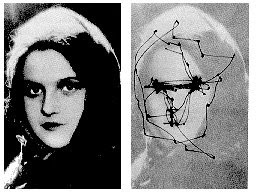
When we see a face, we do the same as with everything else — we zip our fovea around it, concentrating particularly on the eyes and the mouth. Recognising that it’s a face is easy.
But recognising whose face it is, that’s much harder — it requires a very precise assessment of the position of each facial part in relation to each other part. And to recognise whether that face is currently engaged in this facial expression or that facial expression requires quickly seeing how all the various parts of the face have altered relative to each other — their eyes, their eyebrows, their mouth, everything — even as their arrangement is rapidly changing.
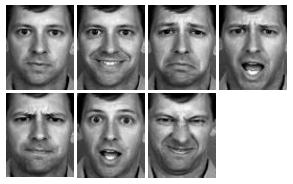
I almost always find that patients who are struggling with reading fluency because of poor macular field integrity also have terrible trouble recognising faces, sometimes even when the person is close enough they could touch them — all this while some of them have a visual acuity which is considered pretty normal.
Note that it’s not an absolute relationship though. Some people have pretty poor overall macular field integrity (and so have problems with faces), but the reading navigator field just happens to be the one part that’s still working okay, so their reading is not bad. Others have a lot of problems with the reading navigation field, but the rest of their macular field is not bad, so they are fine with faces.
Me, I’m terrible at recognising faces in general, so you need to allow for people like me. (Apologies to everyone whose face I’ve mixed up or forgotten, it’s not because I don’t care!). But I can read people’s facial expressions fine, so I know the problem is just my brain linking the face to the person, not a problem with my sight.
And be aware that there are conditions affecting the brain that can cause difficulty with recognising both faces and facial expressions — strokes, brain damage, and some forms of dementia, for example.
Other causes of limited fluency
A less common issue is damage to the reading centres in your brain, which can result from a stroke or other brain damage. This can cause a kind of dyslexia (the word roughly translates as ‘malfunction of reading ability’) or its more severe form, alexia (which roughly means ‘total absence of reading ability’).
Another less common problem is when something’s making it difficult for you to quickly and accurately direct your eyes to move your gaze along the line of text, such as in parkinsons disease.